
Here’s a question I like to ask homeowners:
If you weren’t home and a pipe burst, would everyone else in your house know how to shut off the water?
Most people pause for a second.
They might say, “My wife probably knows.” Or, “I think my son has seen me do it.” Or my favorite: “They’d call me.”
That’s a plan, as long as you answer your phone.
After 48 years as a general contractor, I’ve learned that being prepared isn’t just about you knowing what to do. It’s about making sure the people around you know what to do, too.
The Person Who Knows Everything Isn't Always Home
Most households have one person who knows where things are.
They know where the electrical panel is. They know which valve shuts off the water. They know where the gas meter is. They know which breaker controls the kitchen.
That's great.
Until that person isn't home.
Maybe you're at work. Maybe you're playing golf. Maybe you're traveling. Meanwhile, someone at home notices water coming through the ceiling.
That isn't the best time for a phone conversation that starts with, “Okay, go into the garage and look behind the...wait, no, the other wall.”
Everyone Doesn't Need to Become an Expert
Preparing your household doesn't mean giving everyone a course in plumbing, electricity, and natural gas.
Keep it simple.
Every responsible person in the home should know a few basics:
-
Where is the main water shutoff?
-
Where is the electrical panel?
-
Where is the gas shutoff?
-
Which direction closes the water valve?
-
Where are the tools needed to operate a shutoff?
-
When should they stop and call a professional or emergency services?
Most importantly, they should be able to find this information quickly without relying on memory.
Walk Through Your Home Together
One of the simplest preparedness exercises you can do is a 10-minute household walkthrough.
Show everyone the main water shutoff. Show them the electrical panel. Point out the gas meter and shutoff.
Don't just point and say, “It's over there.”
Let them actually see it.
If appropriate, show them how the water valve operates. Explain the electrical panel. Show them where the gas wrench is kept and make sure everyone understands that shutting off natural gas is a more serious decision—and that the utility or a qualified professional should handle restoring service when required.
Then ask them to show you where everything is.
You'll find out pretty quickly whether they were paying attention.
Why I Created Home Saver Kit
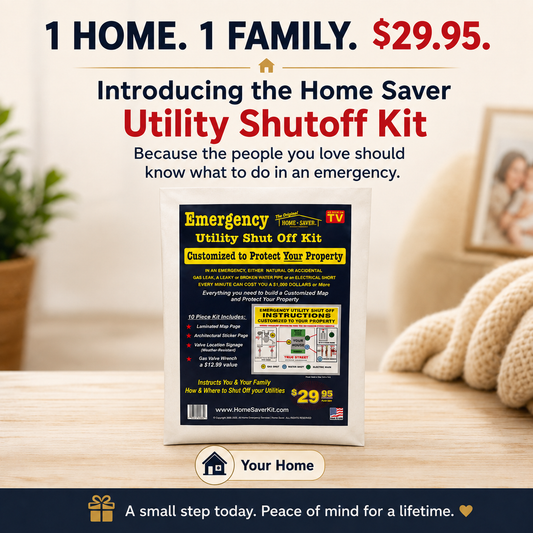
This household knowledge gap is one of the reasons I created the Home Saver Kit.
The Kit gives your family a physical map showing the locations of your utilities, visible tags identifying shutoff points, instructions for what to do, and a gas shutoff wrench stored right where it's needed.
No one has to remember everything.
They just need to know where to look.
And because it's a physical system, it doesn't depend on an app, a charged phone, batteries, or Wi-Fi.
Prepare the People, Not Just the House
You can have smoke detectors, fire extinguishers, emergency supplies, and every tool imaginable.
But your family is still an important part of your emergency plan.
Spend a few minutes walking everyone through your home's utilities.
Because the real test of preparedness isn't whether you know what to do.
It's whether the people you care about know what to do when you're not there.
Be Ready. Be Confident. Be a Home Saver.