
When Something Goes Wrong, You Don’t Have Time to Guess
After nearly 50 years working in homes, I can tell you this:
Most of the damage I’ve seen wasn’t just caused by the problem—it was caused by not knowing what to do in the first few minutes.
A pipe bursts. Someone smells gas. An outlet starts sparking.
In those moments, you need to act quickly and confidently.
This quick guide will walk you through exactly what to do.
WATER: How to Shut Off Your Water
When to Shut Off Water
Shut off your water immediately if you have:
-
A burst pipe
-
A major leak
-
Water flowing where it shouldn’t
Remember—water damage can reach up to $1,000 per minute while it’s flowing.
Where to Find Your Main Water Shutoff
Most homes have a main shutoff valve located:
-
On an exterior wall
-
In a basement or crawl space
-
Outside near the street or sidewalk
How to Shut It Off
There are two common types:
1. Gate Valve (Round Handle)
-
Turn the handle clockwise (right) until it stops
2. Ball Valve (Lever Handle)
-
Turn the lever 90 degrees so it is perpendicular to the pipe
👉 When the valve is closed, water flow stops.
Important Tip
Make sure everyone in your home knows:
-
Where the valve is
-
How to turn it off
Because you may not be the one there when it happens.
GAS: How to Shut Off Your Gas
When to Shut Off Gas
Shut off your gas if:
-
You smell gas (rotten egg odor)
-
You suspect a leak
-
Emergency services instruct you to
Where to Find Your Gas Shutoff
Your gas meter is typically located:
-
Outside your home
-
Along a side wall or near the front
The shutoff valve is on the pipe next to the meter.
How to Shut It Off
-
Use a gas shutoff wrench
-
Turn the valve ¼ turn (90 degrees)
-
When the valve is crosswise to the pipe, it is OFF
Important Safety Notes
-
Only shut off gas if you suspect a problem
-
Once turned off, do not turn it back on yourself
-
Call your gas company to restore service
ELECTRICITY: How to Shut Off Electricity
When to Shut Off Power
Shut off electricity if you notice:
-
Sparking outlets
-
Electrical fire risk
-
Water near electrical systems
-
Malfunctioning equipment
Where to Find Your Breaker Panel
Your electrical panel is usually located:
-
In a garage
-
In a basement
-
In a utility closet
How to Shut It Off
Option 1: Shut Off Individual Circuit
-
Flip the specific breaker to the OFF position
Option 2: Shut Off Entire Home
-
Flip the main breaker to OFF
👉 This cuts power to the entire house.
Important Tip
Label your breaker panel clearly so you know:
-
Which breaker controls what
-
What to turn off quickly
SHARE: Make Sure Others Know
This is one of the most important steps, and one that’s often overlooked.
Ask yourself:
"Would your spouse know what to do? Would your babysitter? Your house sitter? Your kids?"
Take a few minutes to:
-
Show them where everything is
-
Walk them through how to shut it off
Because emergencies don’t always happen when you’re home.
PREPARE: Prepare Before It Happens
The time to figure this out is not during an emergency.
Set aside about 30 minutes to:
-
Locate all your shutoffs
-
Practice turning them off
-
Make a simple plan
That small investment of time can save:
-
Thousands of dollars
-
Stress and confusion
-
Potential safety risks
Final Thoughts
In my experience, the difference between a minor issue and a major problem often comes down to one thing:
How quickly someone acts.
And that comes down to preparation.
Know where your shutoffs are. Know how to use them. Make sure others do too.
👉 Be Ready When It Matters
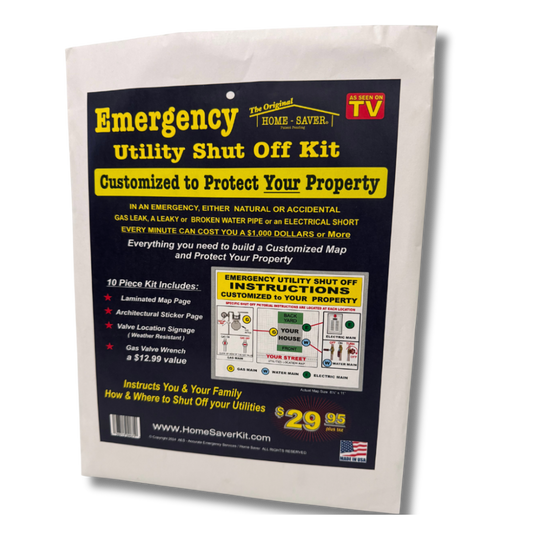
The Home Saver Utility Shutoff Kit is designed to make this process simple, so you and your household know exactly what to do when something goes wrong.
About Home Saver Kit
The Home Saver Utility Shutoff Kit is a simple, low-tech preparedness system designed to help homeowners quickly locate, label, and shut off their water, gas, and electricity during an emergency. Built for real-life situations — not theory — the kit provides clear, physical guidance that works even during power outages, helping families act fast and limit costly damage.
Home Saver Kit was created by Richard “Rick” Koenig, a licensed general contractor with over 48 years of hands-on experience in residential and commercial construction.
Throughout his career, Rick has responded to hundreds of emergency situations and repeatedly saw preventable damage escalate simply because homeowners didn’t know where their shutoff valves were or how to use them. His practical, field-tested approach to preparedness is rooted in decades of real-world problem solving, community involvement, and a commitment to helping homeowners protect what matters most.